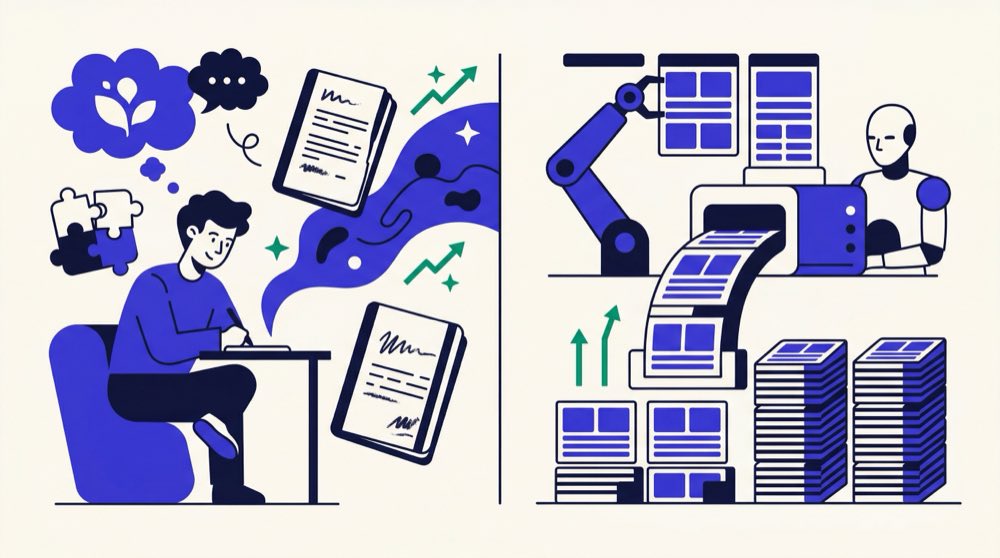
Human-Written vs AI-Generated Content: What Ranks Better in AI Search?
A data-driven comparison of human-written and AI-generated content performance in AI search citations. Covers what AI models actually prefer, how detection works, and the optimal content creation approach for maximum AI visibility.

AI models do not discriminate based on whether content was written by a human or AI. They evaluate content quality signals: information gain, expert attribution, statistical specificity, structural clarity, and E-E-A-T signals. The content that wins in AI search combines AI efficiency for structure and drafting with human expertise for original insights, real data, and authentic experience.
The Real Question: Quality Signals, Not Authorship
The debate over human-written vs AI-generated content misses the point. AI models evaluating content for citation do not ask "was this written by a human?" They ask: "does this content contain information gain, expert attribution, specific data, and structural clarity?"
Google\'s official position reinforces this: their guidelines evaluate content quality regardless of how it was produced. The focus is on whether content demonstrates E-E-A-T — experience, expertise, authority, and trust — not whether a human or AI typed the words.
What AI Models Actually Evaluate in Content
The content characteristics that drive AI citations are independent of authorship:
| Citation Signal | Human Advantage | AI Advantage | Combined Approach |
|---|---|---|---|
| Information gain | Original insights from experience | Cannot generate original data | Human provides insights, AI structures them |
| Expert attribution | Real expert quotes and credentials | Cannot create authentic credentials | Humans provide quotes, AI formats them |
| Statistical specificity | Access to proprietary data | Can research public statistics | Human provides proprietary data, AI finds supporting stats |
| Section structure | Understands reader needs | Excels at consistent formatting | AI handles structure, human ensures accuracy |
| Freshness | Knows what is current | May use outdated training data | Human verifies currency, AI maintains update cadence |
| Tone authenticity | Natural voice | Can sound generic | Human voice direction, AI execution |
The critical insight: the signals that most improve AI citation rates — statistics (+40.9%), expert attribution (+28%), first-person experience (+1.67x) — all require human input. Statistics require access to real data. Expert attribution requires real experts. First-person experience requires someone who has actually done the thing.
AI tools excel at structure, formatting, and efficiency — organizing content into 120-180 word sections, maintaining consistent heading hierarchy, and producing polished prose quickly. The combination of human insight and AI structure produces higher-citation content than either approach alone.
The Optimal Content Creation Approach for AI Visibility
The highest-citation content uses AI as a tool in a human-directed process:
Step 1: Human insight collection. Interview subject matter experts for original insights, proprietary data, and first-hand experience. Capture 2-3 attributed quotes per article. Identify the unique perspective or data point that constitutes the article\'s information gain.
Step 2: AI-assisted drafting. Use AI tools to organize insights into the GEO content framework: direct answer in the first 200 words, 120-180 word sections with clear headings, comparison tables where relevant, and FAQ section.
Step 3: Human expert review. The subject matter expert reviews for accuracy, adds nuance, and ensures the content reflects genuine experience. This step is what separates high-citation content from generic content — the human expert catches inaccuracies, adds specificity, and injects the authentic voice that signals experience.
Step 4: Technical optimization. Ensure structured data is in place, author byline references the correct Person entity, internal links connect to content cluster siblings, and FAQ schema is implemented.
AI Content Patterns That Fail in AI Search
Certain AI-generated content patterns consistently fail to earn AI citations:
Pattern 1: Generic compilation. AI tools that compile information from other sources without adding anything new produce zero-information-gain content. If the article says nothing that 10 other articles do not already say, it will not be cited.
Pattern 2: Unverified claims. AI models occasionally generate plausible-sounding but inaccurate statistics or claims. Content with inaccurate information loses citation trust — AI models cross-reference claims against their training data.
Pattern 3: Missing attribution. AI-generated content rarely includes the "According to [Name], [credential]" attribution format without explicit instruction. Unattributed content misses the 28% citation improvement that expert attribution provides.
Pattern 4: Excessive length without depth. AI tools can produce 5,000-word articles quickly, but length without information density (5+ facts per 100 words) dilutes quality signals. A tight 1,500-word article with original data outperforms a padded 4,000-word article with generic content.
Pattern 5: No first-person experience. AI tools cannot generate genuine first-person experience. Content lacking the "In our experience" or "When we tested this" signals misses the 1.67x citation improvement from first-person bylined writing.
The content quality checklist covers all the signals that determine citation success. For agencies scaling content production across clients, Outrigger monitors which content earns citations and which does not, providing direct feedback on content quality regardless of production method.
Curious whether your content — human-written or AI-assisted — is actually earning AI citations? Run a free AI Visibility Audit — it tests where AI models cite you versus competitors and emails your results with a prioritized content fix list in several minutes.
Frequently Asked Questions
Does Google penalize AI-generated content?
Google\'s official position is that it evaluates content quality, not production method. AI-generated content that is helpful, accurate, and demonstrates E-E-A-T is treated the same as human-written content. However, mass-produced, low-quality AI content that lacks originality and expertise is penalized — not because it is AI-generated, but because it is low quality. The quality standard is the same regardless of the tool used to produce it.
Can AI models detect AI-generated content?
AI detection tools exist but are unreliable, with high false-positive rates. More importantly, AI search models (ChatGPT, Perplexity, Gemini) are not designed to detect AI-generated content — they are designed to evaluate content quality for citation. They assess information gain, accuracy, attribution, and structure. Whether the content was AI-generated is not part of their evaluation criteria.
Should I disclose that content was AI-assisted?
Transparency is generally good practice, but most publications and platforms do not require AI disclosure for edited, AI-assisted content. If AI generated the first draft but a human expert provided the insights, reviewed for accuracy, and ensured quality, the content is human-directed AI-assisted work. Focus on ensuring quality rather than debating disclosure. The content\'s value to readers and AI models is determined by its quality, not its production method.
What is the best AI tool for creating AI-citable content?
The tool matters less than the process. Any capable AI writing tool (Claude, ChatGPT, Gemini) can produce well-structured drafts. The differentiator is your input: original data, expert insights, first-hand experience, and specific examples. Feed any AI tool with high-quality human inputs and a clear structural framework (like the GEO content blueprint) and it will produce a strong first draft. The human review and expertise injection step is where citation quality is determined.
AI audits are currently invite-only
Outrigger is in an invite-only pilot. Existing invited users can sign in for audit access; public access is not open.
Analyze your brandRelated Articles

Content Marketing Strategy for 2026: How AI Changed What Works

What Is Information Gain in AI Search? How Unique Content Wins

E-E-A-T and AI: How Experience, Expertise, Authority, and Trust Drive Citations

How to Build E-E-A-T Signals That AI Models Actually Use