SE Ranking AI Visibility Tracker Review (2026)
A balanced look at SE Ranking's AI Visibility Tracker — what the add-on measures, where it shines for SEO teams, and the GEO gaps you should know about before you rely on it as your AI visibility tool.

SE Ranking's AI Visibility Tracker is a solid add-on for SEO teams who already live inside SE Ranking and want to see whether their brand surfaces in AI Overviews and chatbot answers alongside their keyword rankings. It tracks mentions across major AI surfaces and folds them into the rank-tracking view you already use. It is a strong monitoring layer, but it is a tracker first — it measures visibility rather than executing the off-page citation, entity, and review work that changes it. If you want one platform that both measures across five AI engines and does the citation-building to move the number, pair the tracker with a dedicated GEO platform.
What SE Ranking's AI Visibility Tracker Actually Is
SE Ranking is an established all-in-one SEO platform — keyword rank tracking, site audits, competitor research, backlink monitoring. The AI Visibility Tracker is an add-on layered onto that suite that tells you whether your brand appears in AI-generated answers (Google AI Overviews and mainstream chatbots) for the queries you already track, and shows that data next to your traditional keyword positions.
The core promise is continuity. If your team already runs weekly rank reports in SE Ranking, the AI tracker adds a column of AI visibility to the same workflow rather than making you learn a separate tool. You see, for a given keyword, both where you rank in the classic ten blue links and whether an AI answer names your brand. For SEO teams making the transition from pure search rankings to answer engine optimization, that side-by-side view is genuinely useful.
The smartest thing SE Ranking did here was meet SEO teams where they already work. Most brands do not need convincing that AI visibility matters — they need it to show up inside the reporting they already send clients, and a tracker that bolts onto an existing rank-tracking habit removes that adoption friction. The open question is never whether the tracker sees the problem — it is whether the tool you are paying for does anything to fix it.
This review is based on SE Ranking's public positioning as an SEO suite with an AI visibility add-on. Specific feature availability and pricing tiers change, so confirm current details on their site before you buy.
Where SE Ranking's AI Tracker Is Strong
Several things make the AI Visibility Tracker a reasonable pick for the right team.
It lives inside a mature SEO platform. You are not buying a single-purpose tool that you have to justify separately. Rank tracking, audits, and AI visibility sit in one login, on one bill, in one reporting export. For agencies already standardized on SE Ranking, that consolidation is the single biggest reason to use it.
Keyword-level AI tracking. As publicly described, the tracker sits on top of the keyword database and reports AI visibility per query rather than as a vague brand-wide score. You can see which specific searches trigger an AI answer, and whether your brand made it into that answer. That granularity matters when you are prioritizing which pages and topics to work on.
AI Overviews focus. SE Ranking's public positioning leans hard into Google AI Overviews tracking, which is where a huge share of zero-click behavior now happens. If your traffic loss is concentrated in Google's AI answers, seeing exactly which keywords now show an Overview — and whether you are cited in it — is directly actionable.
Familiar reporting. SE Ranking publicly advertises white-label reports, scheduled exports, and client-ready dashboards as suite features. The AI data flows into that same reporting infrastructure, so client communication does not need a new template.
| Capability | SE Ranking AI Tracker |
|---|---|
| Lives in a full SEO suite | Yes |
| Per-keyword AI visibility | Yes |
| Google AI Overviews tracking | Strong |
| White-label client reports | Yes (suite feature) |
| Rank tracking alongside AI | Yes (native) |
For a team whose primary job is SEO and whose secondary need is to start reporting on AI visibility, that feature set covers the monitoring job well. It is a credible entry into the category discussed in our AI visibility tools comparison.
The GEO Gaps to Know Before You Rely on It
The honest limitation is scope. SE Ranking's AI Visibility Tracker is a measurement layer inside an SEO tool. That defines both what it is good at and where it stops.
Engine coverage is narrower than a dedicated GEO platform. The tracker's strength is Google AI Overviews and mainstream chatbot answers. A brand's real AI footprint spans ChatGPT, Perplexity, Gemini, Google AI Overviews, and Claude — and each retrieves and cites differently. If you only watch the surfaces the tracker prioritizes, you get a partial picture of your share of model.
It measures, it does not build. This is the core point. The tracker tells you that you are absent from an AI answer. It does not seed the Reddit and Quora threads, claim the directory listings, or fix the entity inconsistencies that determine whether AI models retrieve you next time. Closing the gap is off-page citation work, entity work, and review work — none of which a rank-adjacent tracker performs.
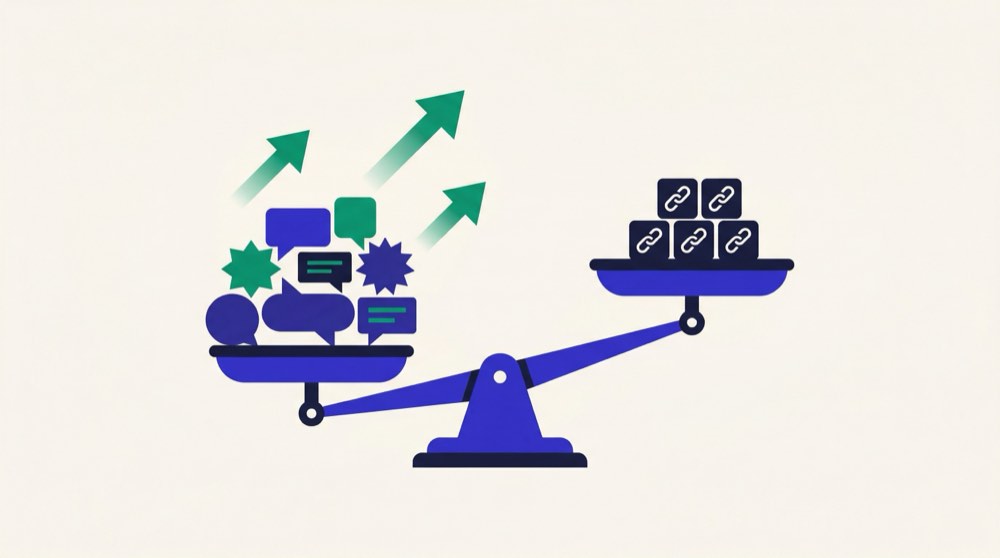
AI citations run on different signals than keyword rankings. SE Ranking's DNA is keyword positions and backlinks. But Ahrefs found brand web mentions have roughly 3x the correlation of backlinks with visibility in Google's AI Overviews (see our brand mentions vs backlinks breakdown). A tool optimized around the keyword-and-backlink model is measuring the AI layer through a lens built for the old one.
See how AI models choose what to cite for why measurement and execution are separate jobs.
Pricing and Who It's For
Based on SE Ranking's public positioning, the AI Visibility Tracker is offered as an add-on to its SEO platform subscription rather than as a standalone product. Pricing follows the suite's tier structure and depends on how many keywords and projects you track. Confirm current numbers directly with SE Ranking, since add-on availability and limits change.
SE Ranking's AI tracker is a good fit if you: - Already use SE Ranking as your primary SEO platform - Want AI visibility reported next to keyword rankings without a second tool - Are focused primarily on Google AI Overviews - Need white-label AI visibility reporting inside an existing client workflow - Treat AI visibility as a monitoring metric, not yet an execution program
It is likely not the right primary tool if you: - Need deep coverage across ChatGPT, Perplexity, Gemini, and Claude, not just Overviews - Want the platform to execute the off-page work that moves the number - Care about entity consistency, directory presence, and review velocity as first-class levers - Are building an AI visibility program rather than adding a reporting column
The simplest way to decide: if AI visibility is a report you send, the tracker may be enough. If AI visibility is an outcome you are accountable for improving, you will need execution the tracker does not provide. Our guide to the best AI SEO tools breaks down where each category of tool fits.
SE Ranking vs a Dedicated GEO Platform
The clearest way to frame the decision is measurement-only versus measurement-plus-execution.
| Dimension | SE Ranking AI Tracker | Dedicated GEO platform |
|---|---|---|
| Primary job | Measure AI visibility | Measure and improve it |
| Engine coverage | Overviews-forward | 5 engines (ChatGPT, Perplexity, Gemini, AI Overviews, Claude) |
| Off-page citation seeding | No | Yes |
| Entity / directory work | No | Yes |
| Review velocity signals | No | Yes |
| Lives inside SEO suite | Yes | Standalone, GEO-native |
| Best for | SEO teams adding AI reporting | Teams running an AI visibility program |
Neither is strictly better — they answer different questions. SE Ranking answers "is my brand showing up in AI answers?" alongside your existing rankings. A dedicated GEO platform answers "my brand is not showing up — what specific off-page, entity, and review moves will change that, and did they work?"
Many teams end up running both: the SEO suite for keyword operations and a GEO platform for the citation-building that actually shifts AI visibility. If you already pay for SE Ranking, the AI tracker is a low-friction way to start watching the problem while you decide how seriously to invest in solving it.
The Outrigger Alternative
Outrigger is built for the half of the problem a rank-adjacent tracker leaves untouched: not just measuring AI visibility, but doing the work that changes it.
The difference comes down to three things:
- Five-engine coverage. Outrigger monitors share of model across ChatGPT, Perplexity, Gemini, Google AI Overviews, and Claude — so you see your full AI footprint, not one surface.
- Off-page citation execution. It discovers the high-authority Reddit and Quora threads AI models already cite and helps you get your brand into them — the off-page work that a tracker can only report on.
- Entity and review work in one place. Directory consistency, entity signals, and review velocity — the raw predictors of AI visibility — are managed alongside monitoring, not bolted on from three separate tools.
Outrigger is not a full SEO suite, and it is honest about that. If you need keyword rank tracking and site audits, keep SE Ranking for that. What Outrigger adds is the execution layer: the citation seeding, entity fixes, and review work that turn an "absent" AI visibility score into a "cited" one. See what that looks like on the features page.
A free AI visibility audit shows where your brand stands across ChatGPT, Claude, Gemini, and Perplexity right now — and exactly which off-page gaps are keeping you out of AI answers. It is the fastest way to see the difference between a tracker that reports the problem and a platform built to close it.
Frequently Asked Questions
Does SE Ranking track AI visibility across ChatGPT and Perplexity?
SE Ranking's AI Visibility Tracker is strongest on Google AI Overviews and mainstream chatbot answers, reported alongside your keyword rankings. Coverage across every engine — ChatGPT, Perplexity, Gemini, and Claude — is narrower than a dedicated GEO platform built to monitor all five. Confirm the current supported surfaces on SE Ranking's site, since the feature set is evolving.
How much does the SE Ranking AI Visibility Tracker cost?
Based on public positioning, it is offered as an add-on to SE Ranking's SEO platform subscription rather than as a standalone product, so pricing follows the suite's tier structure and your keyword and project volume. Because add-on availability and limits change, check SE Ranking's pricing page directly for current numbers.
Can SE Ranking improve my AI visibility, or only measure it?
The AI Visibility Tracker is a measurement layer — it tells you whether your brand appears in AI answers. It does not perform the off-page citation seeding, entity consistency work, or review velocity building that actually moves AI visibility. Improving the number requires execution tools that a rank-adjacent tracker does not include.
Is SE Ranking's AI tracker enough, or do I need a dedicated GEO tool?
If AI visibility is a reporting metric you send to clients and you are focused on Google AI Overviews, the tracker may be sufficient. If you are accountable for improving AI visibility across all five engines — and need the citation, entity, and review execution to do it — pair it with a dedicated GEO platform. Many teams run the SEO suite and a GEO tool together.
Review Your AI Visibility Baseline
The free quick audit covers three core signal groups: Citations, AI Presence, and On-Page foundations. Review available findings and recommendations supported by the evidence the audit could verify.
Analyze your brandRelated Articles
AI Visibility Tools Compared: How to Choose the Right Platform in 2026
Ahrefs Brand Radar & AI Citations Review (2026)
Share of Model: The AI Marketing Metric Replacing Share of Voice
Brand Mentions vs Backlinks: Why Mentions Have 3x the Correlation for AI Overviews