Ads in AI Overviews: What Marketers Need to Know
Google is placing ads inside AI Overviews. Here is how they appear, what changes for marketers, and why earned citations still drive more durable AI visibility than paid placements.

Google now places ads inside AI Overviews - sponsored product and service listings that appear alongside or below the AI-generated answer. These ads buy you a slot in the answer box, but they do not make an AI model recommend your brand in an unpaid response, and they disappear the moment you stop paying. Earned citations - the organic sources an AI model pulls from - remain the durable layer of AI visibility, because they shape what ChatGPT, Perplexity, and Gemini say about you when no ad is running.
What Ads in AI Overviews Actually Are
Ads in AI Overviews are sponsored placements that Google inserts inside or directly beneath the AI-generated answer at the top of a search result. When someone asks a commercial question - "best noise-cancelling headphones for travel" or "emergency plumber near me" - Google's AI Overview summarizes an answer, and around that answer it can now show labeled Sponsored listings - in the formats Google has publicly announced, these include Shopping and Search ads and sponsored product tiles.
This is a real shift. For the first two years of AI Overviews, the answer box was a purely organic surface - Google's model summarized content it retrieved from the open web, and no advertiser could buy their way in. That is no longer true. Google has publicly announced ads inside and adjacent to AI Overviews, and has said it is extending sponsored formats into AI Mode, its fuller conversational search experience. The specific formats and rollout details keep changing, so check Google's current documentation before planning spend around any one placement.
The mechanics matter. An ad in an AI Overview is not the AI recommending you. It is a paid slot rendered next to the AI's answer, clearly labeled Sponsored. The organic part of the answer - the summary itself, and the sources the model cites - is still earned. So there are now two separate games being played in the same box: the paid slot you can buy, and the cited answer you have to earn.
Joel House, founder of Outrigger and author of AI for Revenue, puts it bluntly: "Ads in AI Overviews are Google monetizing the surface it created. They are useful, but marketers keep making the same category error - they assume buying an ad in the answer box means the AI now trusts their brand. It does not. The model still cites whatever sources it independently trusts. The ad sits beside that answer wearing a Sponsored label, and everyone reading it knows the difference."
Why Google Added Ads to the Answer Box
The reason is straightforward: AI Overviews were eating Google's own business model. When an AI answer resolves a query in the result page, the user rarely clicks through - a pattern the data on zero-click search has tracked closely. Fewer clicks means fewer ad impressions on the destination sites and fewer paid clicks for Google. The AI Overview that made search better for users made search worse for Google's revenue.
Ads inside the Overview are how Google reconciles that tension. It keeps the fast AI answer users like while restoring a monetizable slot at the exact moment of highest commercial intent. The full story of how these answer boxes reshaped click-through behavior is covered in how AI Overviews killed CTR - ads are Google's response to the very problem that post describes.
For marketers, the takeaway is that this surface will keep expanding. Where Google puts ads, budgets follow, and where budgets follow, formats multiply. Expect sponsored placements to spread from shopping-heavy queries into local services, B2B, and informational-commercial hybrids over time.
But expansion of the paid layer does not shrink the earned layer. The AI answer above the ad is still assembled from sources the model retrieves and trusts. If your brand is not one of those sources, no amount of ad spend changes what the AI actually says about your category - it only rents you a slot beside that answer.
Paid Slot vs Earned Citation: The Difference That Matters
The single most important distinction for any marketer to internalize is the gap between a paid slot and an earned citation. They look similar on the page. They behave completely differently.
| Dimension | Ad in AI Overview (paid) | Earned citation (organic) |
|---|---|---|
| How you get it | Bid and pay per click | Be a source the model trusts |
| Label shown to user | "Sponsored" | None - reads as the answer |
| Persistence | Ends when budget ends | Persists across future answers |
| Trust signal to buyer | Lower (it is an ad) | Higher (AI chose to cite it) |
| Cross-engine reach | Google surface only | Travels to ChatGPT, Perplexity, Gemini |
| Cost curve | Rises with competition | Compounds as authority builds |
| What it influences | A slot beside the answer | What the answer itself says |
The row that marketers underweight is cross-engine reach. An ad in a Google AI Overview lives only inside Google. It does nothing for how ChatGPT recommends products, how Perplexity answers a research query, or how Gemini describes your category. Earned citations do travel, because the same authoritative sources - your structured content, third-party mentions, reviews, and consistent entity data - are what every model retrieves from.
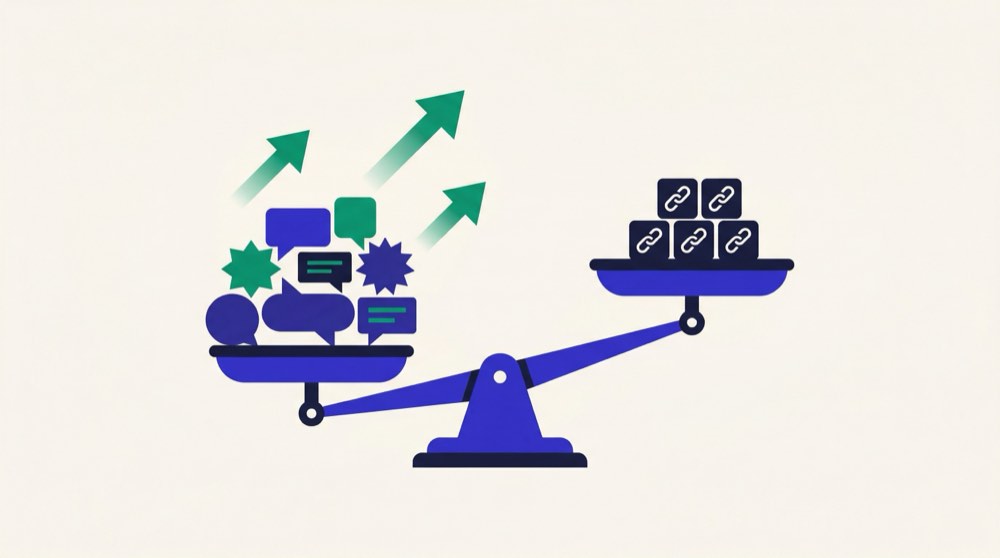
A 2026 study from Outrigger (the Outrigger Visibility Index, spanning 1,004 businesses across 5 AI models and 95,392 data points) found that brand mentions correlate roughly 3x more strongly than backlinks with AI visibility, and that content with structured sections and expert attribution is cited about 65% more often. None of those signals are purchasable through an ad auction. They are earned - and they are what determine whether the AI recommends you when no one is paying for a slot.
Ads buy attention next to the answer; citations buy a place inside it. When a buyer reads an AI summary that names three companies as good options and yours is one of them - unpaid, uncaveated - that carries more weight than any Sponsored tile, because the buyer trusts the model's judgment, not the auction.
How Buyers Actually Read Sponsored AI Answers
Consider a concrete scenario. Suppose someone searches "best CRM for a small real estate team." Google renders an AI Overview that summarizes the tradeoffs and names a few platforms it cites from review sites and comparison articles. Below that summary sits a Sponsored tile for a CRM that bid on the query.
Here is what the buyer processes, whether or not they can articulate it: the summary is Google's AI telling them what is genuinely good, and the tile is a company telling them to buy. People have two decades of training to discount the second and trust the first. The Sponsored label does exactly what it is designed to do - it flags the placement as an ad, and buyers mentally file it accordingly.
This does not make ads worthless. Paid placements still capture clicks, especially for transactional queries where the buyer is ready to act and the sponsored product matches intent. And AI referral traffic converts about 4.4x better than traditional organic, so being present in these high-intent moments has real value.
But the highest-value position is being named in the organic answer itself. If the AI Overview's summary lists your CRM as a strong option for small real estate teams - because it retrieved that from independent review sites and comparison content - you have earned the buyer's trust before they ever see an ad. The company in the Sponsored tile is still trying to buy the trust you already have.
That is the strategic point. Ads and citations are not competitors for budget. Ads work best when they reinforce a brand the AI already cites. A Sponsored tile for a brand the answer already recommended converts far better than one for a brand the answer never mentions - because the ad confirms the AI's judgment rather than contradicting the AI's silence.
What Marketers Should Do Now
The right response to ads in AI Overviews is not to abandon paid or to pour everything into it. It is to make sure your earned layer is strong enough that paid amplifies it instead of substituting for it.
- Audit your current AI visibility. Before spending on ads, find out whether AI models cite you at all today. Monitor what AI says about your brand across ChatGPT, Perplexity, and Gemini so you know your organic baseline.
- Strengthen the sources models retrieve from. Earned citations come from structured, well-attributed content, consistent entity data, third-party mentions, and reviews. These are the same signals whether the query runs on Google, ChatGPT, or Perplexity.
- Treat ads as amplification, not foundation. Run paid placements against queries where you are already cited organically. The ad confirms what the AI already says about you, and that alignment lifts conversion.
- Watch the cross-engine gap. Remember that a Google ad does nothing for the other AI engines. Your earned citations are the only asset that shows up everywhere buyers ask.
- Measure both layers separately. Track ad performance in Google's console and track earned citation share independently. Conflating them hides which layer is actually driving pipeline.
See how Outrigger tracks earned citation share across the major AI engines, and where the durable ROI of AI visibility comes from compared to paid slots.
A free AI visibility audit shows exactly where your brand stands across the AI engines today - and whether an ad in an AI Overview would amplify a brand the AI already cites, or paper over one it currently ignores.
Frequently Asked Questions
Are ads in AI Overviews the same as the AI recommending my brand?
No. An ad in an AI Overview is a paid, labeled Sponsored slot placed beside or below the AI-generated answer. The AI recommending your brand means the model names you inside its organic answer because it retrieved and trusted a source about you. Buyers read these very differently - the Sponsored label flags the ad as paid, while an organic citation reads as the AI's own judgment.
Do ads in AI Overviews help my visibility on ChatGPT or Perplexity?
No. Ads in Google's AI Overviews live only inside Google's search surface. They have no effect on how ChatGPT, Perplexity, Gemini, or Claude answer questions. The only asset that travels across every AI engine is earned citations - the authoritative sources each model independently retrieves from, which are shaped by your content, reviews, entity data, and third-party mentions.
Should I stop running Google ads because of AI Overviews?
Not necessarily. Paid placements still capture high-intent clicks, especially on transactional queries. The mistake is treating ads as a substitute for earned AI visibility. Ads work best as amplification for a brand the AI already cites organically - the Sponsored tile then confirms the model's judgment rather than fighting the model's silence. Build the earned layer first, then let paid reinforce it.
Why did Google add ads to AI Overviews at all?
AI Overviews resolve many queries directly in the result page, so users click through less often. That reduced ad impressions on destination sites and paid clicks for Google, threatening its core revenue. Ads inside the Overview restore a monetizable slot at the moment of highest commercial intent while keeping the fast AI answer users prefer. Expect the sponsored surface to expand into more query types over time.
AI audits are currently invite-only
Outrigger is in an invite-only pilot. Existing invited users can sign in for audit access; public access is not open.
Pilot accessRelated Articles
How AI Overviews Killed CTR by 61% (and What to Do About It)
Zero-Click Search Is Here: What the AI Overviews Data Actually Shows
Can You Advertise on Perplexity or ChatGPT? (2026 Reality)
What Is AI Referral Traffic? Visits From ChatGPT & More