An AI shopping answer can sound cautious and still get the deal wrong
A cautious tone is helpful. The price, service and restriction still need to match the exact purchase.
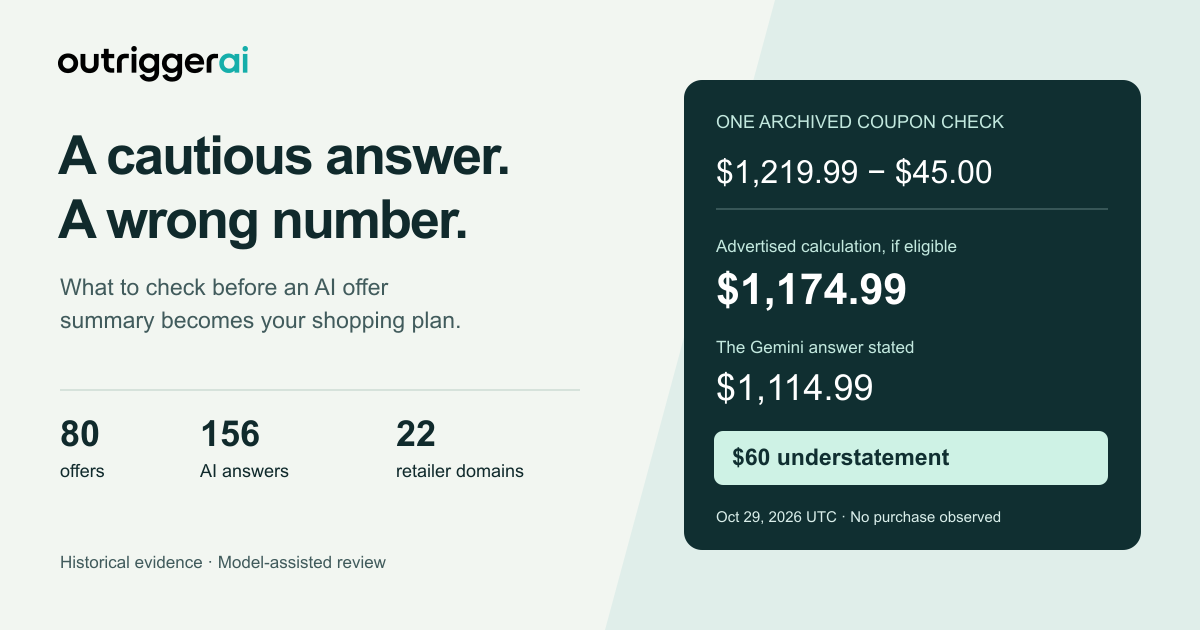
Outrigger reviewed 156 ChatGPT and Gemini answers about 80 promotional offers. The most useful lesson is to check whether each purchase detail matches the exact item and transaction.
A gaming PC was advertised at $1,219.99 with a $45 coupon. Asked to check the offer, Gemini said the code would bring the price to $1,114.99.
The advertised calculation gives $1,174.99. The answer was $60 too low.
That same answer told the shopper to confirm the code at checkout. It contained both a warning and an incorrect price.
This distinction matters when you use AI to help evaluate a purchase. A careful tone, a retailer link and a reminder to double-check can accompany a wrong detail. The question is whether the evidence supports the specific number or condition you plan to rely on.
We examined that question in an Outrigger audit of 80 offers across 22 retailer domains. We asked ChatGPT and Gemini to check supplied product links, prices and variants against retailer information, including shipping, required extras and returns. We preserved their answers and compared material claims with archived retailer evidence.
The review was model-assisted, with separate source checks and adjudication; it was not independent human verification. These are historical offer checks, not recommendations to buy the products at today's prices.
What we tested and what we found
76 answers were unscorable and two were held. Unscorable does not mean false. These counts are not a general error rate or a platform ranking.
This was an offer-verification test. We supplied the product and advertised price, then asked the assistants to explain the purchase accurately and distinguish verified facts from anything needing retailer confirmation. We did not test which assistant could discover the cheapest deal.
The buyer scenario was one selected item, an ordinary nonmember and standard delivery to ZIP 90001 in the United States. The requested details covered the discount conditions, included items, required extras, known cost before sales tax, delivery and returns.
The 80 offers produced 156 substantive answers: 150 from initial attempts and six from permitted technical retries. Those answers received these classifications:
| Review outcome | Answers |
|---|---|
| Contained a verified material error | 36 |
| Accurate but incomplete | 39 |
| Reliable and complete under the audit criteria | 3 |
| Unscorable because material reference evidence remained unresolved | 76 |
| Outcome held pending resolution | 2 |
| Total | 156 |
An answer could contain an established error while other details remained unknown. “Unscorable” does not mean false, and “incomplete” does not mean useless. An appropriately qualified answer could be reliable even when it could not establish a final checkout price.
These counts are not a general AI-shopping error rate. The sample was selected under recorded rules, not randomly drawn from all shopping conversations. Only five offers were explicitly labeled Black Friday by their retailers; the other 75 were other promotions. All 36 verified-error answers came from that latter group. We cannot turn these findings into a Black Friday failure rate or a defensible overall winner between the platforms.
The errors extended beyond the headline price
One answer can appear in several groups. Do not add the rows. The groups were developed after the original review and do not estimate error prevalence.
We conducted a further thematic review of all 36 answers already classified as containing a verified material error. The purpose was to identify the purchase details affected, without changing the original outcomes.
| Area affected by a verified error | Answers within the 36 |
|---|---|
| Price or promotion | 11 |
| Extra charges or totals before sales tax | 10 |
| Shipping or fulfillment | 9 |
| Exact product or included contents | 9 |
| Returns | 8 |
An answer can appear in several rows, so the counts overlap. This was an exploratory analysis after the original review, not a prespecified measure of error prevalence. Several cases came from the same retailers, so these are not independent replications across the market. The error-pattern appendix gives the case memberships and definitions.
The cases show why checking the arithmetic alone is insufficient. Some answers used an incorrect price or reference price. Others omitted a known mandatory fee from a claimed total, described the wrong product configuration, or applied a delivery or return condition that did not fit the selected purchase.
These are descriptions of the observed mistakes, not proof of how the models produced them. Their practical significance is that a plausible fact can still be wrong for the item, seller, destination or service in front of you.
The following three examples show two errors and one useful warning. They illustrate what to inspect; they are not a ranking of the most common problems.
A coupon warning did not fix the coupon calculation
For the Newegg gaming PC, Gemini wrote:
“There is a limited-time promo code GAMINGPC45 which drops the price down to $1,114.99.”
The archived evidence from the Newegg retailer page showed a $1,219.99 item price and advertised “+ $45 off w/ promo code GAMINGPC45, limited offer”.
| Check | Amount |
|---|---|
| Advertised item price | $1,219.99 |
| Advertised coupon reduction | −$45.00 |
| Calculated price if that coupon applies | $1,174.99 |
| Price stated by Gemini | $1,114.99 |
| Understatement | $60.00 |
Gemini also instructed the shopper to confirm that the code was active and deducted the amount in the cart. That was useful caution, but it did not reconcile the incorrect figure already given.
This comparison concerns the advertised calculation in the archived October 29, 2026 (UTC) evidence. It does not establish that checkout accepted the coupon, that a purchase occurred or that anyone lost $60.
Before relying on a discount: calculate it from the stated price and discount, then check the eligible variant, any conditions and the actual cart. An unexplained extra reduction deserves an explanation before it enters your budget.
A delivery disclaimer did not identify the correct service
For a BISSELL machine, ChatGPT put “2–3 business days for machines/formulas” under standard delivery. It also said that the estimate was not a guaranteed arrival date for the shopper's address.
The archived evidence from the BISSELL retailer page distinguished two services:
| Service for machines and formulas | Archived retailer estimate | ChatGPT's standard-delivery estimate |
|---|---|---|
| Standard | 3–4 business days | 2–3 business days |
| Expedited | 2–3 business days | Not described as expedited |
The caution addressed whether an arrival estimate was guaranteed. The error concerned which service the estimate described. Both questions matter, and answering one does not answer the other.
There is a temporal limit here: the relevant policy was captured on October 28 UTC, roughly 19 hours before the answer on October 29 UTC. The archive supports the mismatch with that policy; it does not prove continuous policy stability at the exact answer instant. No actual delivery was measured.
Before relying on a delivery window: match the estimate to the selected shipping method and product category. If arrival timing matters, confirm the destination-specific checkout estimate and whether processing time is separate.
A useful answer connected the restriction to the selected item
The audit also retained useful, correctly supported guidance. For Gymshark Crest Joggers in the selected XS variant, the archived page showed a $15.20 price, a 60% discount and a non-returnable label.
ChatGPT warned:
“You should not expect to return or exchange them for a different size simply because XS does not fit.”
| Evidence | Meaning for the selected purchase |
|---|---|
| Archived evidence from the Gymshark retailer page marked the item non-returnable | The discount came with an ordinary-return restriction |
| The answer applied that restriction to a possible size mismatch | The shopper should resolve fit uncertainty before buying |
The response also preserved the distinction between an ordinary fit return and rights concerning defective or incorrect goods. We are identifying one supported statement here, not certifying every statement in that answer or offering a new legal interpretation.
Before relying on a return policy: check the exact item's status and applicable terms. A store's general returns page may not settle the terms for a clearance item or a marketplace seller.
Three questions to take to checkout
The evidence suggests a practical way to use an AI offer summary: treat it as a list of claims to check against the purchase you are actually making.
- Does the number add up? Separate the item price, eligible discount, required charges and shipping. A subtotal is not a complete total if known mandatory charges are missing. Keep sales tax separate when the quoted total excludes it.
- Does the rule apply to this purchase? Match the product variant, seller, destination, membership status and shipping service. Compare any product image with the selected variant, and check what comes in the box before treating accessories as included or required.
- What is still unconfirmed? Identify unresolved coupon eligibility, delivery dates, availability and return conditions. An honest unknown tells you where retailer confirmation is still needed.
You can ask an assistant to organize those checks, but another answer from the assistant is not independent confirmation. Follow the relevant retailer evidence and inspect the selected cart or terms yourself. This checklist is guidance drawn from the examples; we did not test whether using it reduces mistakes or financial losses.
What this research can establish
The audit documents specific, inspectable contradictions and a useful example of item-specific guidance. It cannot tell us how often every shopper will encounter an error. We did not complete the planned 100-offer collection, make purchases or test real-world delivery and refund outcomes.
The unresolved evidence is substantial: 76 answers remained unscorable and two outcomes were held. Only nine primary pairs, plus two additional retry-assisted pairs, met the audit's comparison requirements with observational limits. Those constraints rule out an overall platform league table from this report.
The methods and detailed results explain selection, retries, review procedures, paired exclusions and the promotion groups. They also distinguish review completion from factual certainty.
The reader's takeaway is a specific habit: before acting on an AI shopping answer, trace the price and the decisive conditions back to the exact purchase. A warning can be helpful. The number, service and restriction still need to be right.