Best Google AI Overviews Trackers Compared
The tools worth using to track whether your brand appears and gets cited in Google AI Overviews, why tracking Overviews is uniquely hard, and how the trackers compare — with honest takes and no invented ratings.

A Google AI Overviews tracker tells you which of your queries trigger an AI Overview, whether your brand is cited in it, and which sources Google pulls into the answer. Trackers like Ahrefs Brand Radar, Semrush, SE Ranking, Profound, and Peec AI monitor this to varying depth, while Outrigger adds the off-page authority work that earns citations rather than just measuring them. Overviews are hard to track because they appear inconsistently and personalize, so treat every tool's numbers as a sample, not an absolute.
Why Track Google AI Overviews Specifically
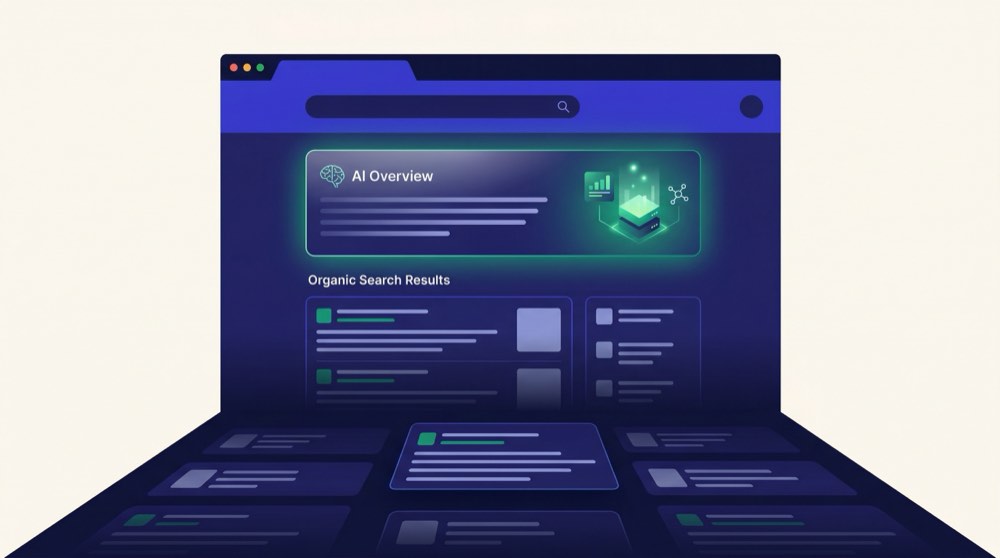
Google AI Overviews are the AI-generated answers that now sit above the traditional blue links for a large share of searches. They matter because they intercept the click. When Google answers the question directly and cites a handful of sources, the user often never scrolls to the organic results — and if you are not one of the cited sources, you are invisible for that query even if you rank #1 below the fold.
This is a different problem from ChatGPT or Perplexity visibility because it happens inside Google, on queries you may already rank for, and it directly cannibalizes the traffic those rankings used to send. Tracking Overviews tells you which of your money queries are being answered without you.
The stakes scale with your reliance on organic search. A business that gets most of its leads from Google is more exposed to Overviews than one that already lives on referrals or paid — because the Overview sits directly on the channel it depends on. For those businesses, an untracked Overview rollout can quietly erode the best-converting traffic they have, and the first visible symptom is a rankings report that looks healthy next to a traffic report that is falling. Tracking Overviews closes that gap between "my rankings are fine" and "my clicks are down," and it does so query by query so you can see exactly where the erosion is happening.
The click impact is well documented — how AI Overviews killed CTR and the zero-click search data cover the erosion in detail. Joel House, the author of AI for Revenue and Outrigger's founder, sums up the stakes: "An AI Overview on a query you rank for is a tax on your best traffic. If Google summarizes the answer and cites three competitors, your ranking is intact and your clicks are gone. Tracking Overviews is how you find the queries where that tax is being levied, so you can go earn a citation in the answer instead of just a link beneath it."
Why AI Overviews Are Hard to Track
Before comparing tools, know the limitations they all work around. AI Overviews are one of the harder AI surfaces to measure honestly.
- They appear inconsistently. The same query can trigger an Overview one day and not the next. Google is still tuning when it shows them, so trigger data is a moving target.
- They personalize. Location, search history, and device change whether an Overview appears and which sources it cites. A tracker checking from one location is sampling one slice of reality.
- Citations are limited and rotate. An Overview cites only a few sources, and which ones can shift between refreshes even for the same query.
- No official rank. As with the LLMs, Google does not expose a "position" inside the Overview. Being cited or not is closer to binary, with prominence as a softer signal.
- They change format. Google keeps redesigning how Overviews look and how many sources they surface, so a tracker's parsing has to keep pace. A tool that worked cleanly six months ago may miss citations after a layout change until it updates.
Because of all this, the right mental model for an Overviews tracker is a weather station, not a speedometer. It gives you conditions and trends across many readings, not a single exact figure you can quote to two decimals. A tracker that samples one query one time and reports a crisp yes-or-no is giving you the least trustworthy version of a genuinely noisy signal. Insist on repeated sampling and be suspicious of false precision.
What this means: every AI Overviews tracker is sampling, not reading a ground truth. The good ones are transparent about it and give you trends and query-level trigger data rather than a false precision. Treat any tool promising an exact, stable Overviews rank the same way you would treat a promised ChatGPT rank — with skepticism.
There is one advantage Overviews have over the LLM engines, though: they live inside Google, so the queries are the same keywords you already track for organic. That makes the gap unusually concrete. You are not guessing at what a customer might type into ChatGPT — you have the exact search terms, their volumes, and your existing rankings. Overlaying "which of these trigger an Overview" and "am I cited" onto your known keyword list turns a fuzzy AI-visibility worry into a specific, prioritized list of money queries to defend. That is why teams with mature SEO programs often find Overviews the easiest AI surface to act on first.
The AI Overviews Trackers
These are the tools that monitor whether your queries trigger AI Overviews and whether you are cited in them, grouped by what they do well.
- Ahrefs Brand Radar — Ahrefs' feature for tracking brand presence in AI answers including Google AI Overviews, built on its large index. Strong for teams already using Ahrefs that want Overviews and AI-mention data alongside backlink and keyword tooling.
- Semrush AI toolkit — Semrush layers AI Overviews and AI-visibility tracking onto its established SEO platform, useful if your keyword and rank tracking already live there.
- SE Ranking — A full SEO suite with AI-answer and Overviews tracking added, generally accessible in price and good for teams wanting rank tracking and AI tracking in one place.
- Profound — Enterprise AI visibility tracking that spans Overviews and the LLM engines, for teams wanting deep, prompt-level data across surfaces.
- Peec AI — AI search analytics with competitor benchmarking that includes Google's AI answers in its share-of-model view.
The SEO-suite options (Ahrefs, Semrush, SE Ranking) are natural if you want Overviews tracking bolted onto traditional rank tracking, since Overviews live inside Google. The dedicated AI trackers (Profound, Peec AI) are stronger if you want Overviews measured in the same frame as ChatGPT and Perplexity. The full AI visibility tools comparison places all of these side by side, and the sibling guides on ChatGPT SEO tools and LLM SEO tools cover the non-Google surfaces.
When you evaluate a tracker, three questions cut through the marketing. First, does it check from the locations your customers are in, since Overviews personalize by geography? A tracker sampling from one country tells a national brand little about a regional one. Second, does it record which sources Google cited, not just whether you appeared? The cited-sources list is the single most actionable output — it is your target list. Third, how often does it sample, given that Overviews trigger inconsistently? A weekly single check is a coarse signal; daily sampling with the sources logged is far more useful. A tracker that answers those three well is worth more than one with a prettier dashboard.
Tracking Isn't Earning: How to Get Cited
Every tool above measures your presence in AI Overviews. None of them, on their own, earns you a citation. That is a separate job, and it is where the actual traffic recovery happens.
Google builds AI Overviews from sources it trusts on that query — a mix of high-ranking pages, authoritative third-party content, and strong entity signals. To get cited, you need content structured so Google can extract a clean answer, entity data consistent enough that Google is confident who you are, and enough third-party authority that Google trusts you as a source worth citing.
- Outrigger — Built inside an agency to do the off-page and entity half of this across all five AI surfaces, including Google AI Overviews. It audits which queries you are missing, identifies the sources Google cites in your category, builds genuine brand mentions and entity consistency, and tracks whether your citation rate improves. It is the tool for teams whose Overviews citation rate is low and who need to earn a place in the answer, not just watch the gap.
The signal weighting is what makes off-page work decisive: Ahrefs' study of 75,000 brands found branded web mentions (r=0.664) have roughly 3x the correlation of backlinks (r=0.218) with visibility in Google's AI Overviews, and Outrigger's study found entity consistency is among the strongest raw predictors. Structuring your pages and building your entity and mention signals is what turns a tracked gap into a citation. Outrigger's features automate that loop.
There is a useful nuance specific to Overviews. Because Google builds them partly from pages that already rank, a page sitting at position four or five that is well-structured and clearly attributed is often a better citation candidate than a thin page at position one. So the recovery play frequently is not "rank higher" — it is "take the pages already ranking on your Overview queries and rewrite them into clean, extractable, expert-attributed answers, then reinforce them with the entity and mention signals that make Google confident enough to quote you." That is a more achievable target than climbing to the top spot, and it is where the citation actually comes from.
A tracker showing you are not cited in an Overview is telling you where to work, not doing the work. The recovery is earning the citation — cleaner content, consistent entity data, and enough trusted mentions that Google reaches for you when it builds the answer.
Trackers Compared and Where to Start
Here is the honest split so you can choose based on your existing stack and whether you want to measure Overviews alone or alongside the LLMs.
| Tool | Best fit | Overviews depth | Earns citations? |
|---|---|---|---|
| Ahrefs Brand Radar | Existing Ahrefs users | Overviews + AI mentions | No |
| Semrush AI toolkit | Existing Semrush users | Overviews + AI tracking | No |
| SE Ranking | Accessible all-in-one | Overviews + rank tracking | No |
| Profound | Enterprise, all surfaces | Deep, cross-surface | No |
| Peec AI | Share-of-model analytics | Overviews in share view | No |
| Outrigger | Fixing low citation rates | 5 AI engines (monitoring) | Yes (off-page) |
The practical approach: if you already run Ahrefs or Semrush, start with their AI Overviews features to see which queries you are losing. If you want Overviews measured alongside ChatGPT and Perplexity, a dedicated AI tracker fits better. Either way, pair the tracker with authority work once you know which queries are being answered without you — measuring the gap is step one, closing it is the return.
And do not treat Overviews as a walled-off project. The entity consistency, structured content, and third-party mentions that earn an Overview citation are the same signals that earn you a place in ChatGPT and Perplexity answers. So the work you do to recover a lost Google Overview query compounds across every AI surface your customers use. Treated that way, an AI Overviews tracker is not a niche tool but the on-ramp to a whole AI-visibility program, starting on the channel where the traffic loss is easiest to see and quantify.
Pricing and Overviews coverage change frequently, so confirm current details on each vendor's site rather than trusting a fixed claim here. And find your starting point first: a free AI visibility audit shows where your brand stands across ChatGPT, Claude, Gemini, and Perplexity, and which competitors are winning the answers you want — the baseline that tells you which queries to fight for and whether you need a tracker, authority work, or both.
Frequently Asked Questions
What is a Google AI Overviews tracker?
A Google AI Overviews tracker monitors which of your target queries trigger an AI Overview, whether your brand is cited in that Overview, and which sources Google pulls into the answer. Because Overviews appear inconsistently and personalize by location and history, trackers sample rather than read an absolute truth — they give you trigger data, citation presence, and competitor comparison over time. Tools like Ahrefs Brand Radar, Semrush, SE Ranking, Profound, and Peec AI offer this to varying depth.
Can I track my exact position in an AI Overview?
No. Google does not expose a ranking or position inside AI Overviews, and which sources it cites can rotate between refreshes even for the same query. Being cited is closer to binary, with prominence as a softer signal. Trackers report whether and how often you appear, not a precise rank, so treat any tool promising an exact, stable Overviews position with skepticism.
Do AI Overviews really reduce my traffic?
Yes, on queries where they appear. When Google answers directly above the blue links and cites a few sources, many users never scroll to the organic results, so clicks fall even when your ranking is unchanged. If you are not one of the cited sources, you effectively lose that query. This is the zero-click dynamic that has eroded organic CTR, which is why tracking which of your money queries trigger Overviews matters.
How do I get my brand cited in Google AI Overviews?
Google cites sources it trusts on a query, so getting cited means structuring your content for clean extraction, keeping your entity data consistent so Google is confident who you are, and building enough third-party authority that it reaches for you. Brand mentions and entity consistency are among the strongest predictors of AI visibility. Trackers show the gap; off-page authority work like Outrigger's closes it.
Review Your AI Visibility Baseline
The free quick audit covers three core signal groups: Citations, AI Presence, and On-Page foundations. Review available findings and recommendations supported by the evidence the audit could verify.
Analyze your brandRelated Articles
How AI Overviews Killed CTR by 61% (and What to Do About It)
Zero-Click Search Is Here: What the AI Overviews Data Actually Shows
AI Visibility Tools Compared: How to Choose the Right Platform in 2026

Best ChatGPT SEO Tools (What Actually Tracks ChatGPT)