ChatGPT Citations: How They Work and How to Earn One
When ChatGPT search answers a question, it cites sources. This is the definitive guide to how ChatGPT surfaces and selects those citations, which draw on the Bing index and the live web, and exactly what earns your brand a citation.

ChatGPT earns citations by retrieving live web pages, primarily through the Bing index, and quoting the ones that most clearly answer the query. When ChatGPT search runs, it issues search queries, pulls candidate pages, reads them, and grounds its answer in the passages that directly and completely address the question. To earn a citation you need three things: your page must be indexed by Bing and rank for the query, it must contain a clean, self-contained passage that answers the question, and your brand must be corroborated by third-party sources so the model trusts you. Structure, freshness, and consensus win the citation.
Two Kinds of ChatGPT Answers: Trained vs Retrieved
ChatGPT produces two very different kinds of answers, and citations only exist in one of them. Understanding the split is the foundation of everything else.
Trained-knowledge answers come from the model's internal weights — what it absorbed during training. These have no live sources and no citations. If your brand appears here, it is because you were prominent enough in the training data to be memorized. You cannot directly optimize this in the short term; it is a slow, downstream effect of broad web presence.
Retrieved answers come from ChatGPT search: when the model decides a question needs current or specific information, it runs live web searches, reads the returned pages, and grounds its answer in them. These answers carry citations — the little source links attached to claims. This is the surface you can actually optimize, and it is where GEO effort pays off.
ChatGPT's retrieval draws primarily on the Bing search index plus live web fetching — a dependency that is publicly documented through OpenAI's partnership with Microsoft. That single fact reorders your priorities: Bing indexing and Bing visibility matter for ChatGPT citations in a way most SEO teams, fixated on Google, completely neglect.
The trained-versus-retrieved split also explains why brands sometimes see contradictory results: ChatGPT may describe your company accurately from training data yet never cite you in search-grounded answers, or the reverse. Those are two separate systems with two separate inputs, and they should be diagnosed separately. A missing trained-knowledge presence is a long-term brand-footprint problem that only broad, sustained web presence fixes. A missing citation is usually a mechanical retrieval problem you can fix this quarter: an unindexed page, a buried answer, or thin corroboration.
In the words of Joel House, founder of Outrigger and author of AI for Revenue: "The biggest blind spot I see is teams pouring everything into Google and never once checking whether Bing has even indexed their key pages. If Bing has not crawled your page, you are invisible to ChatGPT search no matter how well you rank on Google. Step one of earning a ChatGPT citation is embarrassingly basic: confirm Bing can find you." For the mechanics shared across all engines, the guide on how AI models choose sources covers the retrieval-and-grounding pattern in depth.
How ChatGPT Selects and Attaches Citations
When ChatGPT search handles a query, the process runs roughly like this:
- Query formulation. ChatGPT turns your question into one or more search queries. A complex question may spawn several.
- Retrieval. It fetches candidate pages, primarily via the Bing index, then may fetch the live pages themselves.
- Reading and grounding. The model reads the retrieved content and drafts an answer grounded in it, favoring passages that answer the query directly and completely.
- Citation attachment. Sources that materially shaped specific claims get cited with a visible link. A page can inform the answer without being cited, but the clearest, most quotable sources earn the visible attribution.
Several factors decide whether your page becomes a cited source: - Retrievability. Indexed by Bing and ranking for the query. No retrieval, no citation. - Passage clarity. A self-contained block that answers the question in 40-80 words, positioned where the model finds it fast. - Specificity and evidence. Concrete numbers, named examples, and dates make a passage more quotable than vague prose. - Freshness. For time-sensitive queries, recently updated pages are strongly preferred. - Trust and corroboration. The model favors sources it deems credible, which is shaped by how consistently other authoritative sources describe and reference your brand.
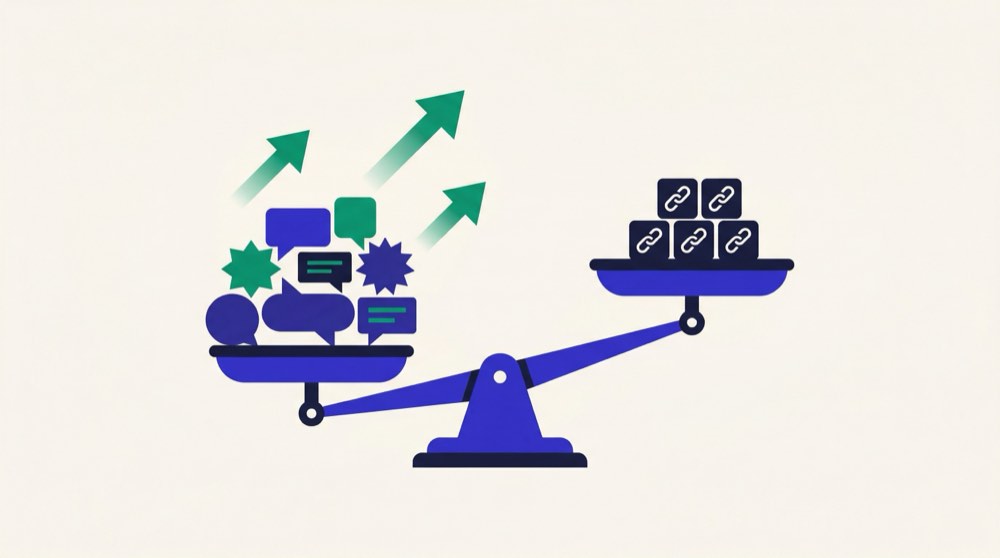
That last factor is why off-page work matters so much. A 2026 study from Outrigger found brand mentions correlate roughly 3x more strongly than backlinks with AI visibility — the model's confidence in citing you rises when independent sources corroborate who you are. The relationship between brand mentions and backlinks is central to earning citations, not just rankings.
It helps to think of a citation as a two-part decision. First, retrieval: can the model find a page of yours that answers the query? Second, trust: is the model confident enough in that page and that brand to attach its name to the claim? Most teams obsess over the first half and ignore the second. They build a well-structured page, it gets retrieved, and then the model quietly declines to cite it because nothing outside that page corroborates the brand. Closing the trust half — consistent identity, reviews, mentions in credible articles — is often what converts a page that merely informs an answer into a page that gets the visible citation.
8 Steps to Earn a ChatGPT Citation
This is the actionable core. Work top to bottom.
- Confirm Bing indexing. Submit your sitemap in Bing Webmaster Tools and verify your priority pages are indexed. This is the non-negotiable first step for ChatGPT citations.
- Rank for the underlying queries. ChatGPT retrieves what search returns. Solid on-page SEO and topical authority get you into the candidate set.
- Write passage-first content. Lead each section with a direct, self-contained answer to that section's question. Every such block should stand alone if quoted verbatim — this is the citable content structure the model harvests.
- Use question-shaped headings and FAQ blocks. Each Q/A pair is a pre-packaged, citable answer. FAQPage schema helps the model parse them.
- Add specificity. Replace vague claims with numbers, named examples, dates, and comparisons. Specific passages get quoted; generic ones get skipped.
- Keep pages fresh. For anything time-sensitive, update and re-date content. Freshness materially affects retrieval for current-information queries.
- Build third-party corroboration. Reviews, directory listings, and mentions in authoritative articles create the consensus that raises the model's confidence in citing you. This is the multi-source consensus effect at work.
- Reinforce brand entity signals. Organization schema, consistent identity across the web, and a clear category help the model resolve who you are before it decides to quote you.
Sequence matters here too. Steps one through five are within your direct control and can be completed in weeks; steps six through eight accrue over months. The common mistake is inverting the order — chasing mentions and reviews while priority pages sit unindexed on Bing or open with three paragraphs of preamble. Fix the mechanical layer first, because every unit of trust you build afterward multiplies against pages that are actually retrievable and quotable. A review campaign pointed at pages Bing has never crawled is effort spent on the half of the equation that was not the bottleneck.
Outrigger tracks whether ChatGPT cites your brand for your priority questions and which pages it pulls, turning an invisible process into a measurable one.
What Gets Cited vs What Gets Ignored
The gap between a cited page and an ignored one is usually structural, not topical. Here is the contrast.
| Attribute | Ignored by ChatGPT | Cited by ChatGPT |
|---|---|---|
| Bing status | Not indexed | Indexed and ranking |
| Answer placement | Buried after preamble | Direct answer up top |
| Passage design | Long unbroken paragraphs | Self-contained 40-80 word blocks |
| Evidence | Unsourced generalities | Specific numbers, examples, dates |
| Freshness | Stale, undated | Recently updated, dated |
| Brand trust | Fuzzy, uncorroborated | Consistent identity, third-party mentions |
| Format | Wall of marketing copy | Question-shaped headings, tables, FAQs |
Consider a concrete example. Suppose a B2B software company wants ChatGPT to cite it for "best project management tools for remote agencies." A page titled with that exact question, opening with a direct 60-word answer naming the tool's differentiator, followed by a comparison table and an FAQ addressing pricing and integrations — that page is quotable at the passage level. A competitor's page that opens with three paragraphs of brand story before mentioning any feature is not. If the first company is also indexed by Bing, corroborated by reviews, and freshly updated, it wins the citation even if the competitor has a bigger domain.
Notice what is absent from that contrast: domain size, brand fame, and publishing volume. Those help indirectly — bigger brands accumulate corroboration faster — but none of them substitutes for the structural work. That is unusually good news for smaller companies. In classic search, outranking a large competitor on a head term can take years of link building; in ChatGPT search, out-answering them on one specific question is often a one-page project. The playing field is not level, but it is far more level than the one most SEO teams grew up on, and it tilts toward whoever answers the question most clearly.
Earning a ChatGPT citation is not mystical. It rewards the least fashionable habits in content: answer the question first, be specific, keep it current, and make sure the rest of the web agrees you are who you say you are. Do those four things on an indexed page and you will be cited far more often than a bigger competitor who does none of them.
Measuring and Compounding ChatGPT Citations
ChatGPT citations are largely invisible in standard analytics. Referral traffic from ChatGPT is thin and inconsistently attributed, so you have to measure the citation itself, not just the click.
Track monthly: - Whether ChatGPT cites your brand for a fixed set of buyer questions - Which specific pages get cited when it does - Which questions surface competitors instead of you - Your Bing indexing status for priority pages - Your third-party corroboration: reviews, mentions, directory presence
Run the same question set each month, log who gets cited, and treat the competitor-owned questions as your content roadmap. Because ChatGPT answers vary and evolve, the trend over time is what matters, not any single query.
When you log results, record more than a yes or no. Note the phrasing of the answer, which competitor pages were cited alongside or instead of yours, and whether the model used search at all for that question — some queries never trigger retrieval, and no amount of page optimization will earn a citation on an answer generated purely from training data. Over a few cycles this log tells you which of your priority questions are genuinely winnable retrieval battles and which need a different strategy, such as building the broader web presence that shapes future training runs.
The economics reward the effort. AI referral traffic converts roughly 4.4x better than traditional organic, per a 2026 study from Outrigger, because a user who arrives from a ChatGPT citation has already been pre-sold by a trusted intermediary. A single well-placed citation can outperform pages of ordinary search clicks.
Citations also compound. Each one is a signal that reinforces your presence, and the corroboration you build for ChatGPT simultaneously helps Perplexity rank your source and Gemini recommend you. There is also a reinforcing loop worth naming: the more ChatGPT cites you in retrieved answers, the more your brand appears in the web content that trains future models, which raises the odds you eventually surface in trained-knowledge answers too. In other words, winning the retrieval game today seeds the training game tomorrow. That is why consistency matters more than any single campaign — a brand cited steadily for a year builds a presence that becomes self-sustaining, while a brand that earns a citation and then goes quiet fades from both the index and the model's memory. A free AI visibility audit shows whether ChatGPT currently cites your brand and where the fastest citation gains are hiding. The cross-engine sequence lives in the platform-by-platform GEO guide.
Frequently Asked Questions
How does ChatGPT decide which sources to cite?
When ChatGPT search runs, it formulates search queries, retrieves candidate pages primarily via the Bing index, reads them, and grounds its answer in the passages that most directly and completely address the question. Sources that materially shaped specific claims get a visible citation. Retrievability, passage clarity, specificity, freshness, and brand trust all influence the choice.
Does ChatGPT use Google or Bing for citations?
ChatGPT search draws primarily on the Bing search index plus live web fetching, not Google. This is a common blind spot: teams optimize only for Google and never confirm Bing has indexed their pages. Submitting your sitemap in Bing Webmaster Tools and verifying indexation is the essential first step to earning ChatGPT citations.
Why isn't my brand cited even though it ranks on Google?
Google rankings do not guarantee ChatGPT citations because ChatGPT retrieves via Bing, not Google. Your page may be strong on Google but absent or weak on Bing, or it may lack a clean, self-contained passage that answers the query. Missing third-party corroboration can also lower the model's confidence in citing you even when the page ranks.
How long does it take to earn a ChatGPT citation?
It varies. Once a well-structured, indexed page is retrievable and your brand has some third-party corroboration, citations can appear within weeks. Building the trust and consensus that make citations consistent takes longer, typically a few months. Freshness helps time-sensitive queries surface faster, while durable authority accrues gradually.
AI audits are currently invite-only
Outrigger is in an invite-only pilot. Existing invited users can sign in for audit access; public access is not open.
Pilot accessRelated Articles

How AI Models Decide Which Brands to Recommend (And Why Yours Might Not Make the List)

How to Structure Content in Self-Contained Citable Units
Perplexity Citations: How Perplexity Chooses Its Sources
Platform-by-Platform GEO: How to Optimize for ChatGPT vs Perplexity vs Gemini vs Claude