Thought Leadership for AI Search: How Personal Brands Drive Company Citations
Personal brand authority directly drives company AI citations. When executives publish thought leadership content with strong E-E-A-T signals, their company gets cited more by AI models. Learn the specific mechanism and implementation strategy.

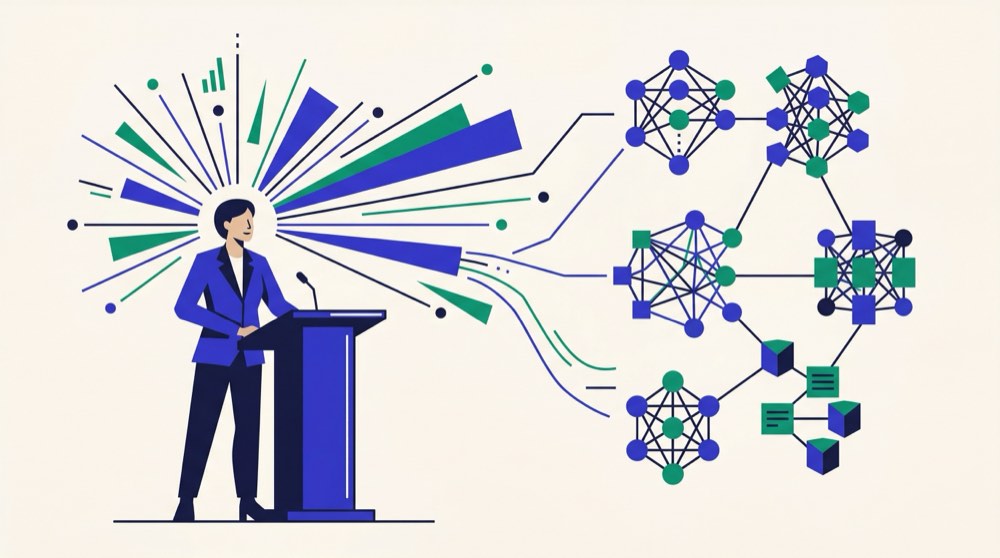
Personal brands drive company citations in AI search. When an executive with strong E-E-A-T signals publishes content that mentions their company, AI models associate the individual\'s expertise with the brand. This person-to-company authority transfer is one of the most effective and underutilized AI visibility strategies.
How Personal Brands Drive Company AI Citations
AI models are entity-aware — they understand relationships between people and organizations. When an executive with verified expertise publishes content that references their company, AI models create an association: this expert works at this company, therefore this company has expertise in this domain. The personal brand\'s E-E-A-T signals transfer to the company.
First-person writing with author bylines yields 1.67x citation improvement. This statistic measures exactly this mechanism — when AI models can attribute content to a named individual with verifiable credentials, they cite it more confidently. The author\'s expertise becomes a citation signal for everything they produce, including company-published content.
The Thought Leadership Content Strategy
Effective thought leadership for AI visibility combines original insight with strategic distribution across platforms AI models retrieve from.
Content types that build personal brand authority:
| Content Type | Platform | AI Citation Value | Frequency |
|---|---|---|---|
| In-depth articles | Company blog (with author byline) | Very high | Weekly |
| LinkedIn articles | High | Weekly | |
| Podcast appearances | Apple/Spotify (transcripts indexed) | Medium-high | Monthly |
| Conference talks | Published slides/video transcripts | Medium-high | Quarterly |
| Medium articles | Medium | High | 1-2x monthly |
| Industry publication quotes | Trade media | Very high | As available |
| Book authorship | Amazon, publisher sites | Highest (permanent) | Once |
The content differentiation principle: Thought leadership content must contain information gain — original insights that cannot be found elsewhere. Repackaging common knowledge under a personal byline does not build authority. Each piece should include at least one of: proprietary data, a unique framework, a contrarian perspective backed by evidence, or a specific experience-based insight.
Building the Personal Brand Entity for AI Recognition
For AI models to transfer personal authority to a company, the person-company connection must be explicit and verifiable across multiple sources.
Step 1: Establish the entity home.
Create a canonical personal page (e.g., joelhouse.com/about or your company\'s team page) with comprehensive bio, professional history, published work, and speaking engagements. Implement Person schema with worksFor connecting to the Organization entity.
Step 2: Create consistent sameAs connections.
LinkedIn, Twitter/X, Medium, and any other professional profiles should all:
- Use the same professional headshot
- Include the same company affiliation
- Link to the entity home page
- Use consistent name formatting
Step 3: Publish under your personal name across platforms. Every article, guest post, podcast appearance, and social post builds the named entity\'s authority. Consistency is critical — publishing as "Joel House, Founder of Outrigger" across all platforms creates a clear entity signal.
Step 4: Get quoted and referenced by others. The strongest personal brand signal is third-party citation — being quoted in articles you did not write, referenced in forum discussions, and cited by other experts. Digital PR campaigns should specifically pursue expert quotes and thought leadership placements, not just brand mentions.
Step 5: Maintain the author entity connection on every piece of content. Every blog post on your company site should include the author\'s byline, brief credential, and a link to their author page. The Article schema should reference the Person schema. This creates a persistent, machine-readable connection between the personal authority and the company content.
Beyond the CEO: Multi-Voice Thought Leadership
While CEO or founder visibility often provides the strongest initial authority signal, building thought leadership across multiple team members multiplies the effect.
Why multi-voice matters for AI: AI models assess organizational expertise partly by the number of recognized experts associated with the company. A company with three visible experts — a CEO discussing strategy, a CTO discussing technology, and a VP discussing operations — signals deeper organizational expertise than a company with a single public voice.
Implementation: - Identify 2-4 team members with distinct expertise areas relevant to your business - Build author entity pages for each on your website - Assign content topics based on each person\'s specific expertise - Each author publishes under their own name on both the company blog and external platforms - Cross-reference each other in content ("As our CTO [Name] discussed in her article on...")
The team visibility effect: When multiple employees from the same company are publishing authoritative content across different platforms, AI models encounter the company brand repeatedly through different expert voices. This creates a richer, more credible company entity signal than any single author can build alone.
For CEO-specific visibility strategies, see the dedicated guide. For the technical implementation of author entities with structured data, see the entity SEO guide. Outrigger\'s audit tracks author entity recognition alongside brand entity signals as part of the E-E-A-T assessment within the 6-pillar framework.
Curious whether your executives\' personal brand is actually transferring authority to your company in AI answers? A free AI Visibility Audit checks how AI models recognize your author and brand entities together and emails you the results in several minutes.
Frequently Asked Questions
Does the CEO need to write the content personally?
The content needs to contain the executive\'s genuine insights, but it does not need to be drafted by them personally. The most efficient approach: interview the executive for 15-20 minutes to capture specific insights, data, and perspectives, then have a writer structure the content. The executive reviews for accuracy and adds any additional nuance. The insights must be real — AI models and readers detect generic content that merely carries a name.
How much time should an executive spend on thought leadership?
A minimum viable commitment is 2-3 hours per week: one 20-minute interview for content creation, one hour reviewing and approving content, and one hour engaging on LinkedIn (posting, commenting, responding). This cadence produces 1-2 pieces of thought leadership content per week across platforms. The time investment decreases as systems and processes develop.
Can thought leadership work for B2C brands?
Yes, particularly for founder-led brands where the founder\'s story is part of the brand identity. Think fitness brands (founder\'s training philosophy), food brands (chef founder\'s approach), or lifestyle brands (founder\'s mission). For larger B2C brands, product experts or category specialists can fill the thought leadership role. The mechanism is the same: personal expertise signals transfer to brand authority in AI model evaluations.
How long until thought leadership affects AI citations?
Initial entity recognition takes 4-8 weeks of consistent publishing across platforms. AI citation impact typically appears within 60-90 days as the author entity builds cross-platform presence and content accumulates. The authority transfer from personal brand to company brand accelerates over time — after 6 months of consistent thought leadership, the compound effect creates a significant and durable AI visibility advantage.
AI audits are currently invite-only
Outrigger is in an invite-only pilot. Existing invited users can sign in for audit access; public access is not open.
Analyze your brandRelated Articles

E-E-A-T and AI: How Experience, Expertise, Authority, and Trust Drive Citations

How to Build E-E-A-T Signals That AI Models Actually Use

CEO Branding in the AI Era: Why Executive Visibility Equals Company Visibility
LinkedIn for AI Visibility: Leveraging the #2 Most-Cited Domain