JSON-LD Schema Recipes for AI Search: Copy-Paste Templates for Every Page Type
Ready-to-use JSON-LD schema templates for every page type that impacts AI visibility. Covers Organization, Person, Article, FAQPage, Product, Review, and BreadcrumbList schema with AI-specific optimizations explained.

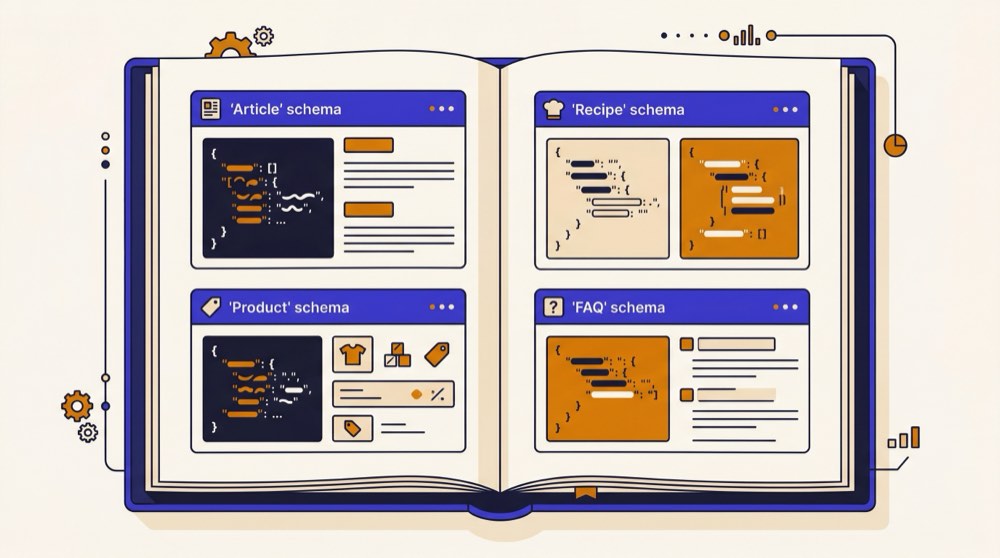
JSON-LD is the preferred format for structured data that AI models read. These ready-to-use templates cover every major schema type for AI visibility — Organization, Person, Article, FAQPage, Product, and Review — with the specific properties that AI models use for entity verification and citation confidence.
Why JSON-LD Matters for AI Citations
JSON-LD (JavaScript Object Notation for Linked Data) is the structured data format that Google recommends and that AI models process most effectively. Content with schema has a 2.5x higher chance of AI citation. JSON-LD provides the machine-readable entity data that AI models use for verification, relationship mapping, and citation confidence.
The templates below include every property that impacts AI visibility — not just the minimum required by Google. Each template is annotated with which properties matter most for AI citations and why. For the conceptual foundation, see What Is Structured Data. For the complete technical guide, see the schema markup guide.
Organization and Person Schema Templates
Organization Schema (homepage): This is your brand\'s core entity definition. Every property contributes to entity authority.
Key properties for AI visibility:
- name: Exact brand name (consistent everywhere)
- description: 1-2 sentence positioning (matches other platforms)
- url: Official website
- logo: High-resolution logo URL
- foundingDate: Year founded
- founder: Reference to Person entity
- sameAs: Array of ALL official profile URLs (LinkedIn, Twitter, Wikidata, Crunchbase, etc.)
- knowsAbout: Array of expertise topics
- address: Business address (if applicable)
- contactPoint: Customer service contact
The sameAs array is the most important property for AI citation confidence — it explicitly connects all your platform identities into one verified entity.
Person Schema (author/team pages):
Key properties for AI:
- name: Full professional name
- jobTitle: Current role
- worksFor: Reference to Organization entity
- sameAs: Professional profile URLs (LinkedIn, personal site, Twitter)
- knowsAbout: Expertise areas
- description: Brief bio highlighting credentials
- url: Canonical personal page (entity home)
The Person schema connects author E-E-A-T signals to your Organization entity. First-person writing with author bylines yields 1.67x citation improvement — and this improvement increases further when the author has a well-defined Person entity.
Article and FAQPage Schema Templates
Article Schema (every content page):
Key properties for AI:
- headline: Article title
- description: Article summary
- author: Reference to Person entity (not just a name string)
- publisher: Reference to Organization entity
- datePublished: Publication date (ISO 8601)
- dateModified: Last update date (triggers freshness signals)
- image: Article image URL
- mainEntityOfPage: The canonical URL
The author property should reference a full Person entity, not just a name string. This creates the author-to-article-to-organization chain that AI models follow for E-E-A-T evaluation. Update dateModified with every content refresh — 76.4% of cited pages were updated within 30 days.
FAQPage Schema (any page with Q&A content): Pages with FAQPage schema are 3.2x more likely to appear in AI Overviews. This is the highest-impact single schema type for AI citation.
Key properties:
- mainEntity: Array of Question entities
- Each Question has: name (the question text) and acceptedAnswer with text (the answer)
FAQPage schema guidelines: - Include ALL visible Q&A content in the schema (Google penalizes partial markup) - Answer text must match visible page content - Keep answers to 50-80 words for optimal AI extraction - Include on blog articles, product pages, service pages — any page with Q&A sections
See the FAQ optimization guide for the complete strategy on creating AI-optimized FAQ content.
Product, Review, and BreadcrumbList Templates
Product Schema (product/service pages):
Key properties for AI:
- name: Product name
- description: Product description
- brand: Reference to Organization entity
- offers: Pricing information (price, currency, availability)
- aggregateRating: Star rating and review count
- review: Individual review references
Product schema helps AI models understand what you sell, at what price point, and how customers rate it. When AI models receive product comparison queries, Product schema data feeds directly into their comparison synthesis.
Review / AggregateRating Schema:
Key properties:
- reviewRating: Star rating value
- author: Reviewer name
- reviewBody: Review text excerpt
- datePublished: Review date
- aggregateRating: Overall rating with ratingValue and reviewCount
Review schema surfaces customer evidence in structured format. AI models reference this data when evaluating the Trust component of E-E-A-T.
BreadcrumbList Schema:
Key properties:
- itemListElement: Array of breadcrumb items with name and item (URL)
BreadcrumbList signals topical organization to AI models — it shows how your content is categorized and connected. A clear breadcrumb path (Home > Blog > AI SEO > This Article) tells AI models that your content exists within a structured topical authority framework.
For implementation validation, use the structured data audit checklist. The 6-pillar audit through Outrigger includes automated schema validation as part of the entity pillar assessment.
Want to see which of these schema types your site is missing? Run a free AI Visibility Audit — about 20 minutes, and it emails you exactly which schema gaps are costing you AI citations.
Frequently Asked Questions
Where do I add JSON-LD on my website?
Add JSON-LD in a `<script type="application/ld+json">` tag in the `<head>` section of each page. Most CMS platforms (WordPress, Shopify, Webflow) have plugins or settings that add schema automatically. For custom sites, add the script tag directly to your page templates. You can include multiple JSON-LD blocks on a single page — one for Organization, one for Article, one for FAQPage.
Do I need different schema for every page?
Organization schema goes on your homepage (or every page with the same content). Person schema goes on author/team pages. Article schema goes on every blog post and content page. FAQPage schema goes on every page with Q&A content. Product schema goes on product pages. Each schema type targets different entity signals. Implement all relevant types for maximum AI citation impact.
How do I test if my schema is working correctly?
Use Google\'s Rich Results Test (search.google.com/test/rich-results) to validate your JSON-LD syntax and check for errors. Use Schema.org\'s Markup Validator for comprehensive validation. Check Google Search Console for schema-related issues. After implementation, monitor whether rich results appear for your pages in Google search — this confirms Google is processing your schema correctly.
Does schema implementation require a developer?
For CMS platforms with schema plugins (WordPress SEO plugins, Shopify apps), implementation can be done without developer help. For custom websites or advanced schema (connected Person-Organization entities, Product with nested reviews), developer assistance is recommended to ensure correct implementation. The templates above can be adapted by anyone comfortable editing HTML, but the entity relationship connections benefit from technical review.
AI audits are currently invite-only
Outrigger is in an invite-only pilot. Existing invited users can sign in for audit access; public access is not open.
Pilot accessRelated Articles

Schema Markup for AI Search: What Actually Gets You Cited in 2026

Entity SEO: How to Make Google and AI Models Understand Your Brand
What Is Structured Data? The AI Visibility Advantage Explained
JSON-LD Schema Recipes for AI Search: Copy-Paste Templates for Every Page Type